CVSS:4.0AV:N / AC:L / AT:NPR:L / UI:N / …
SEVERITY ≠ PRIORITY
 Illustration of a working environment
Enrolment opening soon
Security test planning
Learn to turn a general request to check security into a workable assessment plan. Practice client conversations, test-model selection, scope definition and responses to changing circumstances. Prepare documents organizing collaboration from engagement start to retest.
PLN 449planned price including tax
In your browser · No installation · Tutor and narration
Open your browser. Start learning.
Do not spend your first evening configuring an environment. The application, tools and task context are in one place. You do not need Docker, a VPN, a virtual machine or paid software.
A virtual tutor walks you through the example and highlights important parts of the application, code or tool. Connect the instruction to what is happening on screen.
Narration explains the mechanism, decision and result. Pause the guidance, return to an earlier step and work through it at your own pace.
Take over in the exercise: change data, run a test or make a decision. Compare the result and improve your solution using the explanation.
One environment, without switching between a video and a local installation. Tools fit the topic: from HTTP requests and code to a terminal, calculator or document. Practice in simulators and prepared cases, without attacking other people's systems.
What will you be able to do?
Turn a general security request into a plan understood by tester and client. Also practice scope changes and accounting for completed work.
The client asks for a pentest, but everyone means something different.
Record the goal, expected outcome and required access. Justify a black-box, gray-box or white-box model.
You do not know what to ask or what must remain untouched.
Prepare scope and questions. Treat a new host or integration as a change requiring agreement, not automatic permission.
You struggle to show which planned work was actually tested.
Create a scope-change record and work summary with limitations and closure conditions.
Practice engagement discussions as a beginning consultant or assessment buyer. Documents require approval by the appropriate parties.
Connect each skill to a concrete work product. Return to explanations while you practice.
A syllabus backed by materials
See what makes up the syllabus: lessons, explanations, examples and exercises. The figures below describe different types of materials.
The figures describe the English-language source materials. The waiting list is for the planned Polish edition. These counts do not mean its translation is complete. Demonstration steps, examples and tasks are different units, not hours of video or counts of unique vulnerabilities.
Entry point
Available in Polish and English — you can switch language at any time. Command names, code snippets and standard identifiers remain in their original form.
How you learn
The tutor walks through an example and explains each decision. In the exercise, return to the context, check the result and improve your answer.
Goal, constraints and inputs. Know what you are testing and why.
Watch a demonstration with tutor commentary, step by step.
Work with data, a tool or a scenario. Compare the result with your expectation.
Justify your decision and understand its limitations. Return to anything that needs improvement.
Exercises use simulators and selected mechanisms that run in the browser. They do not require attacking other people's systems.
Planned syllabus
Each area develops a specific skill. Learn not only the topic but also the action and outcome that learning leads to.
Each topic includes a skill and a concrete exercise outcome.
I want to join the listClarify the decision the client wants to make after the assessment and the expected work product. Choose a vulnerability assessment or pentest and a black-box, gray-box or white-box model. Establish access, time, constraints and information needed before starting.
Tutor-guided exercise
Build a matrix of allowed, restricted and excluded assets, including external services. Record who approves specific actions and how scope extensions are handled. Practice distinguishing permission to read from permission to change state.
Tutor-guided exercise
Trace the roles of customer, seller and operation approver. Mark data flows and trust boundaries, then prepare abuse scenarios. Turn each scenario into a test question within the authorization scope.
Workshop with prepared data
Choose WSTG methods for application features, available roles and assessment priorities. Sequence actions, link them to evidence identifiers and consider expected defensive traces. Also plan how to record tests that find no vulnerability.
Workshop with prepared data
Define the required record of input, result, context and interpretation. Agree data minimization, storage and handover rules. Prepare a template supporting test reproduction and identification of untested aspects.
Tutor-guided exercise
Practice pressure to expand testing, unexpected data and an event requiring tests to stop. Apply agreed contacts and escalation rules. Prepare a decision record and communication allowing authorized work to resume safely.
Case analysis
Compare the plan with the activity log and materials actually produced. Separate completed tests, limitations and outstanding items. Present coverage through actions, not merely a list of WSTG references.
Workshop with prepared data
Define retest conditions, handover scope and material retention and deletion rules. Summarize findings, responsibilities and the client's next decisions. Produce a coherent closure package for review by the appropriate people.
Workshop with prepared data
In practice
Each case has context, a concrete action and an outcome. The goal is not to memorize a command but to understand why the result changed.
Clarify the goal, access model and roles, then build a scope matrix. Match tests to application functions and record evidence, stop-work and retest rules.
Work productDraft engagement rules and an execution plan linked to test questions.
Analyze a new resource or action requiring an additional decision. Prepare an escalation record, then compare the plan with the log and actual materials at closure.
Work productA change register, justified assessment coverage and closure conditions.
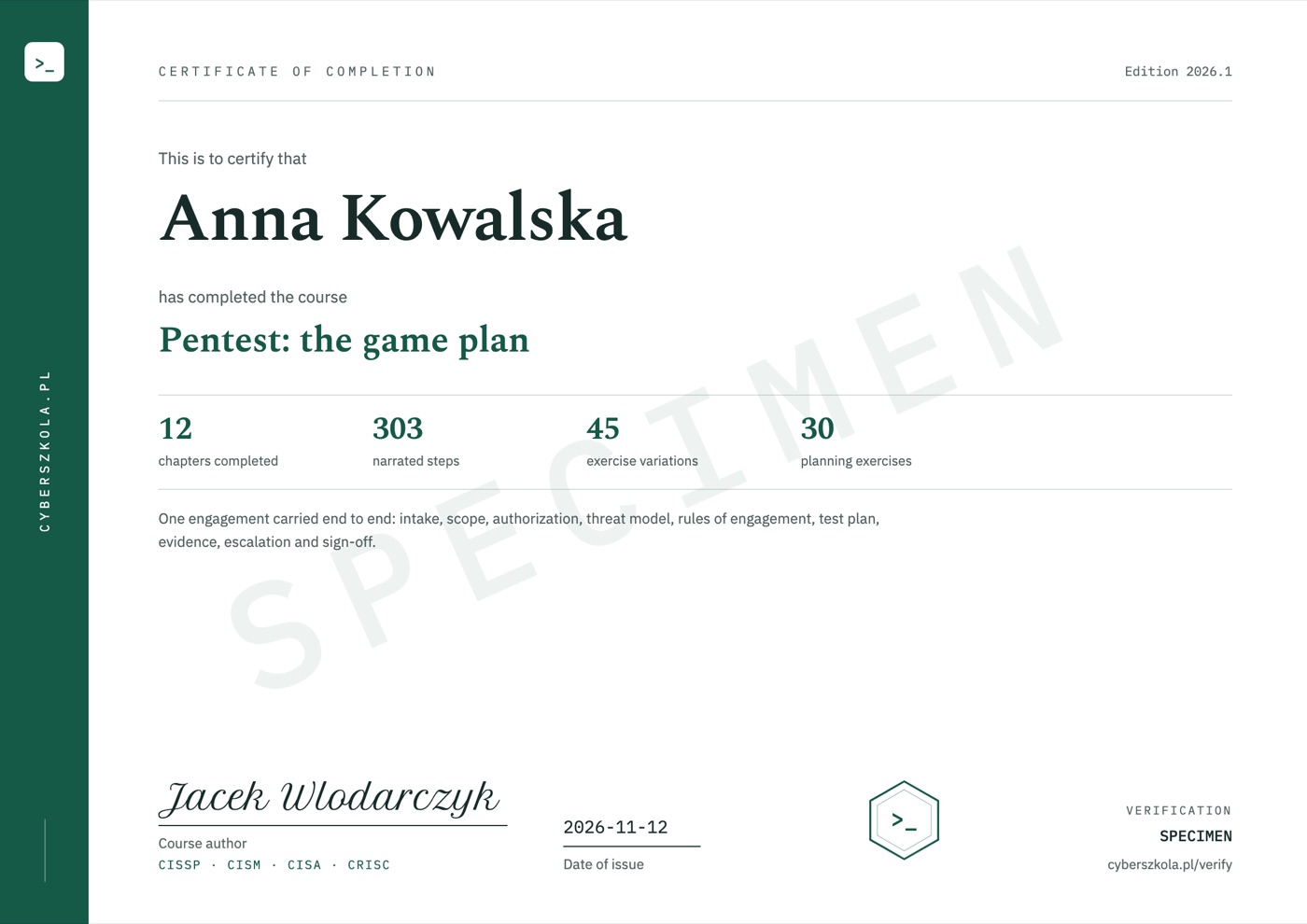
Certificate of completion
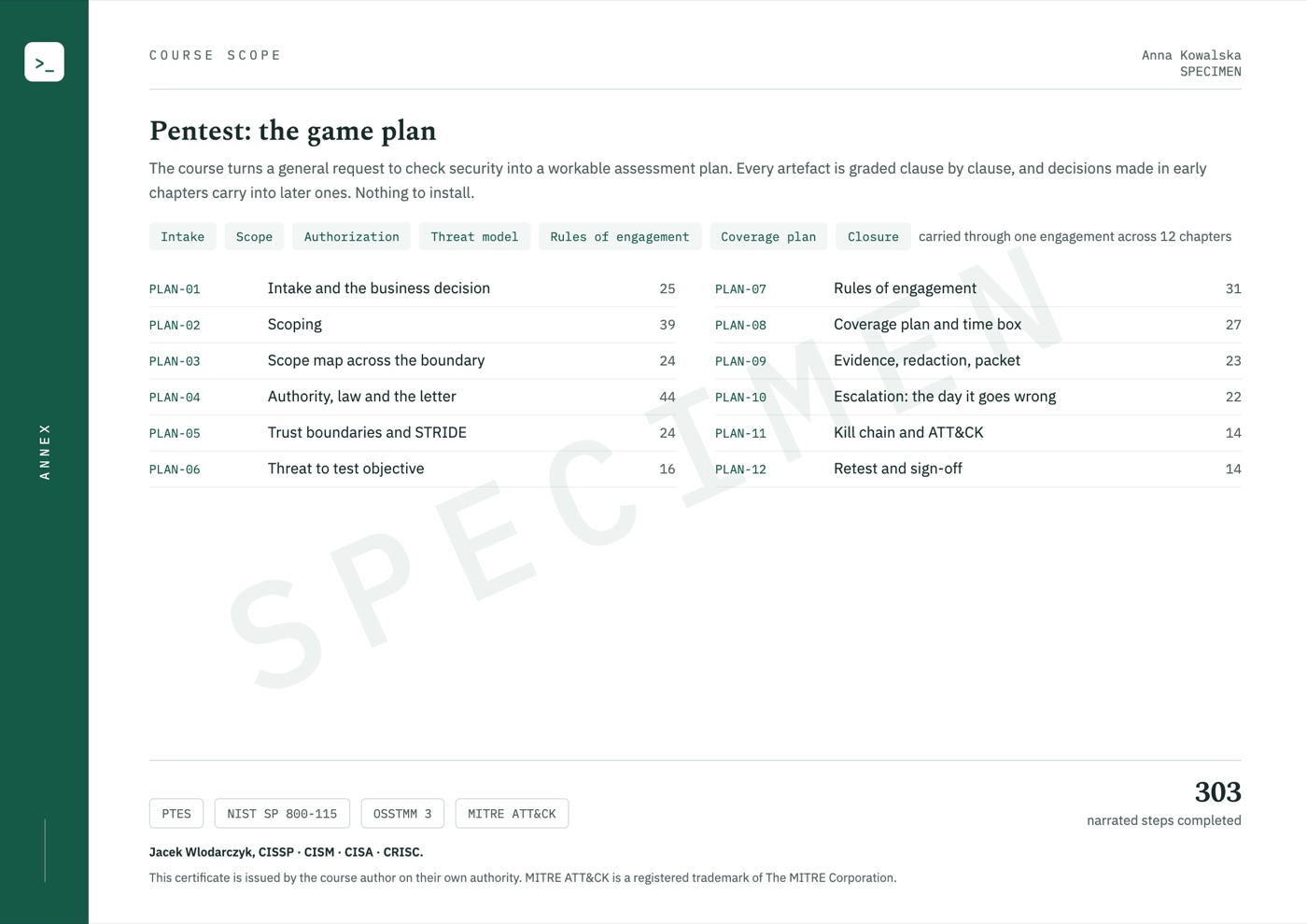
When you complete the course, the certificate is issued automatically and emailed to you. It shows your name, the date of issue and a unique code, and its second page lists the course scope.
Code verification: cyberszkola.pl/verify
Upcoming standalone course
Planned course price
Polish edition · Launch date not yet announced
Notify me at launchJoining is free. Before sales open, you will receive the date, full scope and purchase terms. We are not taking payments today. This is a separate interest list, not a place reservation or purchase.
For companies and teams
Compatible with LMS platforms including:
and other platforms that support e-learning standards.
Price for companies
Delivery into your company's own LMS from 50 licences.
Ask for a quoteWrite to [email protected]: the number of people, the courses you want and your LMS, if you use one.

Project author
Creator of Cyberwiedza, cyberszkola and AI SecLabs. In these courses, I connect explanations of mechanisms with practice, observation and decisions you need to justify.
Running a command is not enough. What matters is what its output confirms, what it does not confirm and what the next step should be.
More about the authorBefore joining
No ready-made attack knowledge is required at entry. Understanding the assessment's purpose matters more. The course teaches questioning, scope selection and work organization; testing techniques can be developed in the web course.
Yes. Learn the decisions worth making before an assessment and how to account for coverage. This helps prepare a request, agree responsibilities and assess a proposed plan.
No. This is an upcoming course announcement and an interest list. Joining is not a purchase, a place reservation or a commitment to pay.
The launch date, price and access terms will be announced before sales open. The interest list is how we send that information.
The course is available in Polish and in English — you can switch language at any time, and lessons, exercise explanations and narration exist in both. Commands, code and tool names keep their original syntax, as used in everyday work.
No. All course exercises run in your browser on a computer with internet access. Training applications, terminals, editors and workshops are part of the platform. You do not install Docker, a virtual machine or a VPN, and you do not need paid external tools.
No. You work in an interactive environment. A virtual tutor highlights important elements, and narration explains the action and its result. Pause the lesson, return to earlier steps and run your own experiments. This guidance is built into the course, not individual consultation with a person.
No. You use training applications, simulators and prepared data. Learn the mechanism and its limitations in a safe environment. External resources are supplementary, not required to complete the exercises.
Yes, a certificate of completion. When you complete the course, you receive a certificate in English with a unique code that anyone can check at cyberszkola.pl/verify. It confirms completion of the course and is issued by the author; it is not an industry certification. We do not promise employment.
No. These are independently authored courses using public references and original cases. They do not replace licensed standards, accreditation or qualifications required in regulated industries.
Join the waitlist
Leave your email address. We will send you news of enrollment, the syllabus and first-edition terms. You will not need to keep checking this page.
Planned price: PLN 449 including tax